Studying Law in the Digital Age: How Bahra University Is Preparing Future Legal Professionals
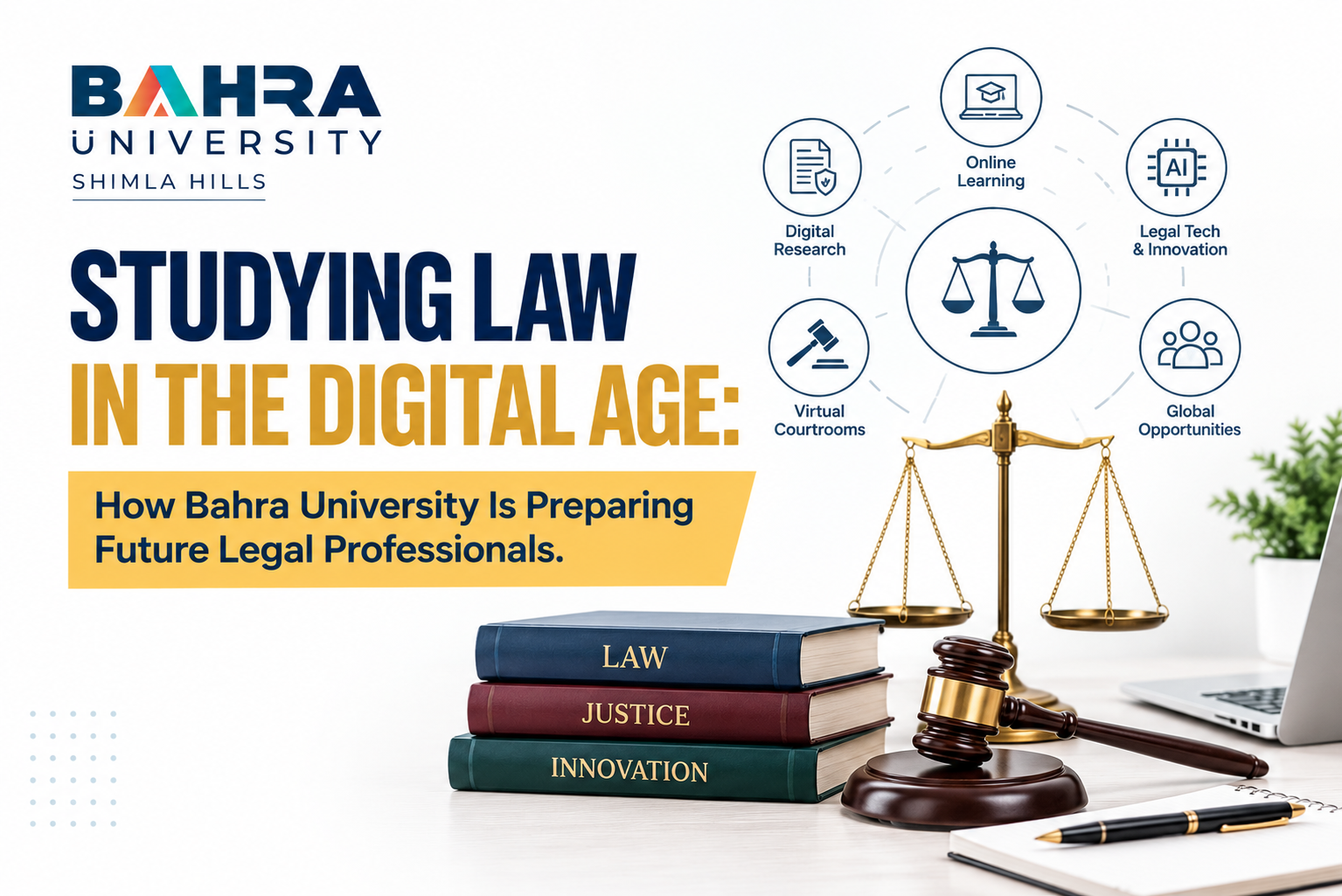
Law has always been connected with society, business, government, and human rights. But the way legal work is done is changing quickly. Court records are being digitised, legal research is moving online, contracts are increasingly reviewed using technology, and lawyers are expected to understand data, privacy, artificial intelligence, and cybercrime.
For today’s law students, learning legal provisions from textbooks is no longer enough. They must also know how to research digitally, evaluate online information, prepare documents efficiently, communicate professionally, and understand the ethical challenges created by technology.
At Bahra University, Shimla Hills, the School of Law combines legal education with practical activities such as moot courts, youth parliaments, seminars, conferences, legal camps, and legal-aid work. These activities help students move beyond theoretical learning and develop the confidence and professional skills required in modern legal practice.
Why Legal Education Is Changing
Technology is affecting almost every area of law. Businesses collect personal information, companies sign digital contracts, financial transactions take place online, and disputes increasingly involve electronic records. Cybercrime, online fraud, intellectual-property issues, data protection, artificial intelligence, and digital evidence are now important legal subjects.
The Indian judiciary is also becoming more technology-enabled. The e-Courts Mission Mode Project is currently in Phase III, covering the period from 2023 to 2027, with a financial outlay of ₹7,210 crore. The project focuses on e-filing, e-payments, digitisation of court records, virtual and hybrid hearings, online case information, and paperless court systems.
Government data indicates the scale of this transformation. By the end of 2025, high courts and district courts had digitised hundreds of crores of pages of records, while video-conferencing facilities had expanded across courts and prisons. More than 3.81 crore online hearings had reportedly been conducted by September 2025.
These developments show why future lawyers need digital confidence. A law student may work with electronic documents, online databases, digital filings, video hearings, and technology-based evidence well before becoming a senior professional.
Building Strong Legal Foundations
Technology cannot replace the fundamentals of legal education. A capable lawyer must still understand constitutional principles, legislation, precedent, legal interpretation, reasoning, ethics, and procedure.
Bahra University’s School of Law offers legal programmes and focuses on helping students build professional confidence through academic and co-curricular activities. The university organises moot court competitions throughout the course, along with youth parliaments, seminars, conferences, and legal camps.
These activities are valuable because they develop skills that examinations alone cannot measure. Students learn how to read a legal problem, identify relevant issues, research authorities, prepare arguments, respond to questions, and present their position clearly.
A moot court, for example, gives students the opportunity to act as advocates. They prepare written submissions, study legal provisions, use case law, and argue before a panel. The experience helps students understand that legal practice involves preparation, precision, persuasion, and professional conduct.
Moot Courts and Advocacy Skills
Moot courts remain one of the most useful activities for law students. They simulate courtroom arguments and encourage students to connect legal theory with practical advocacy.
Through moot-court participation, students can develop:
- Legal research and case analysis.
- Written submissions and drafting.
- Oral advocacy and courtroom etiquette.
- Time management and teamwork.
- The ability to answer unexpected questions.
- Confidence in presenting complex arguments.
These skills remain relevant even outside litigation. Corporate lawyers, legal consultants, policy professionals, compliance officers, and in-house counsel must all explain legal positions clearly to clients, managers, regulators, and colleagues.
At Bahra University, moot court competitions are presented as a regular part of the law-school experience rather than an occasional activity. This can help students develop confidence gradually instead of encountering professional-style arguments only at the end of their degree.
Digital Legal Research
Legal research is one of the areas most affected by technology. Students now use online case-law databases, legislation portals, court websites, legal journals, government notifications, and digital libraries.
However, digital access does not automatically mean good research. Students must learn how to:
- Identify reliable legal sources.
- Distinguish primary law from commentary.
- Check whether a judgment remains valid.
- Read the facts, issues, reasoning, and final decision of a case.
- Use correct citations.
- Compare conflicting judgments.
- Avoid relying on unverified online summaries.
At Bahra University, the faculty profile includes teachers with research and legal experience. For example, Dr. Mandeep Verma is listed as having published research papers and a book on witnesses in the criminal justice system. The profile also notes experience as an advocate at the District and Sessions Court, Shimla, and responsibility for the university’s Legal Aid Clinic.
This combination of research and practical exposure can help students understand that legal research is not simply collecting case names. It involves analysing facts, evaluating reasoning, identifying legal principles, and applying them to new situations.
Understanding Cyber Law and Digital Evidence
The growth of digital transactions has created new legal challenges. Cyber law covers areas such as hacking, identity theft, online fraud, cyberstalking, data breaches, intermediary responsibility, electronic contracts, and digital privacy.
Digital evidence may include emails, messages, CCTV footage, metadata, server logs, social-media posts, mobile-phone data, and computer files. Lawyers must understand how such material is collected, preserved, authenticated, and presented.
Students do not need to become cybersecurity engineers to work with digital evidence, but they should understand its basic nature and limitations. They should know why chain of custody matters, how electronic records can be challenged, and why technical evidence often requires expert assistance.
This is especially important for criminal law, corporate disputes, intellectual-property matters, banking, taxation, and regulatory compliance.
Legal Aid and Social Responsibility
A legal education should not be limited to private careers. It should also help students understand how law affects ordinary people.
Bahra University’s School of Law organises legal camps aimed at spreading legal awareness and contributing to society. The faculty profile also identifies a Legal Aid Clinic associated with the School of Law.
Legal-aid work can expose students to issues that may not appear in a classroom problem. They may encounter questions involving domestic violence, consumer rights, labour disputes, access to government schemes, documentation, or the rights of disadvantaged communities.
This experience teaches students how to communicate legal information in simple language. It also helps them understand that a legal solution must be practical, accessible, and sensitive to the circumstances of the person seeking help.
Research and Innovation in Legal Education
Technology has also changed legal research and academic innovation. Law students can now explore subjects such as artificial intelligence and law, privacy, digital currencies, cybercrime, intellectual property in software, online dispute resolution, legal technology, and algorithmic accountability.
At Bahra University, our Research and Development Cell actively encourages faculty and students to participate in publications, conferences, books, patents, projects, workshops, and seminars. We are committed to fostering innovation and building a strong research-oriented academic environment.
For law students, research opportunities can lead to seminar papers, journal articles, policy briefs, dissertations, competitions, and conference presentations. These activities help students develop specialisation and may be useful for careers in academia, policy research, legal publishing, consulting, and advanced study.
The university’s law faculty includes teachers pursuing doctoral research, publishing papers, attending conferences, and working in specialised areas such as constitutional law, environmental law, criminal law, business law, commercial law, and banking law.
Preparing for Different Legal Careers
A law degree can lead to many career paths. Some graduates become advocates, while others work in law firms, corporate legal departments, compliance teams, courts, government agencies, legal-process outsourcing, policy organisations, research institutions, or non-governmental organisations.
Digital transformation is creating additional roles and specialisations. These include:
- Cyber-law practice.
- Data-protection and privacy compliance.
- Technology contracts.
- Intellectual-property protection.
- Corporate compliance.
- Legal operations.
- Alternative dispute resolution.
- Online dispute resolution.
- Legal research and publishing.
- Policy and technology regulation.
Students should use their university years to explore different areas. Internships, court visits, moot courts, legal-aid activities, research projects, and conversations with practising lawyers can help them decide which direction suits them.
The Human Skills Technology Cannot Replace
Digital tools can make legal work faster, but they cannot replace professional judgment, ethics, empathy, negotiation, and responsibility. Lawyers deal with people facing disputes, financial pressure, criminal accusations, business uncertainty, and personal loss.
A future legal professional must therefore be comfortable with technology without losing the human side of the profession. They must protect confidentiality, verify information, avoid misleading clients, understand conflicts of interest, and use digital tools responsibly.
This is why activities such as youth parliaments, seminars, conferences, legal camps, and moot courts remain important. They build communication, leadership, teamwork, public speaking, and social awareness alongside legal knowledge.
Conclusion
Studying law in the digital age requires a balance between traditional legal foundations and modern technological awareness. Students must learn statutes, cases, legal reasoning, and ethics, but they must also understand electronic evidence, online research, digital filings, cybercrime, privacy, artificial intelligence, and technology-driven court systems.
Bahra University is preparing students for this changing environment through moot courts, legal camps, seminars, conferences, youth parliaments, research opportunities, and legal-aid activities. Its faculty profile also reflects expertise across several legal areas, including criminal law, environmental law, constitutional law, business law, commercial law, and international trade.
The future lawyer will not be defined only by the ability to quote a legal provision. The profession will increasingly reward people who can research accurately, use technology responsibly, communicate clearly, think critically, and understand the human consequences of legal decisions. A law education that develops all these abilities can prepare students not only for today’s legal profession, but also for the profession it is becoming.
