AI-Proof Careers: How Bahra University Helps Students Build Future-Ready Skills
Artificial intelligence is not simply eliminating careers, it is reshaping them. The most resilient professionals will not be those who avoid AI, but those who can combine technical fluency with judgement, creativity, communication, and ethical responsibility. Bahra University is positioning its students for this reality through industry-linked programmes, practical learning, certifications, and structured career preparation.
The New Meaning of “AI-Proof”
The term AI-proof career can be misleading. Few jobs will remain untouched by automation, but many will become more valuable for people who can do what machines cannot do reliably: interpret ambiguity, build trust, make accountable decisions, lead teams, and solve unfamiliar problems.
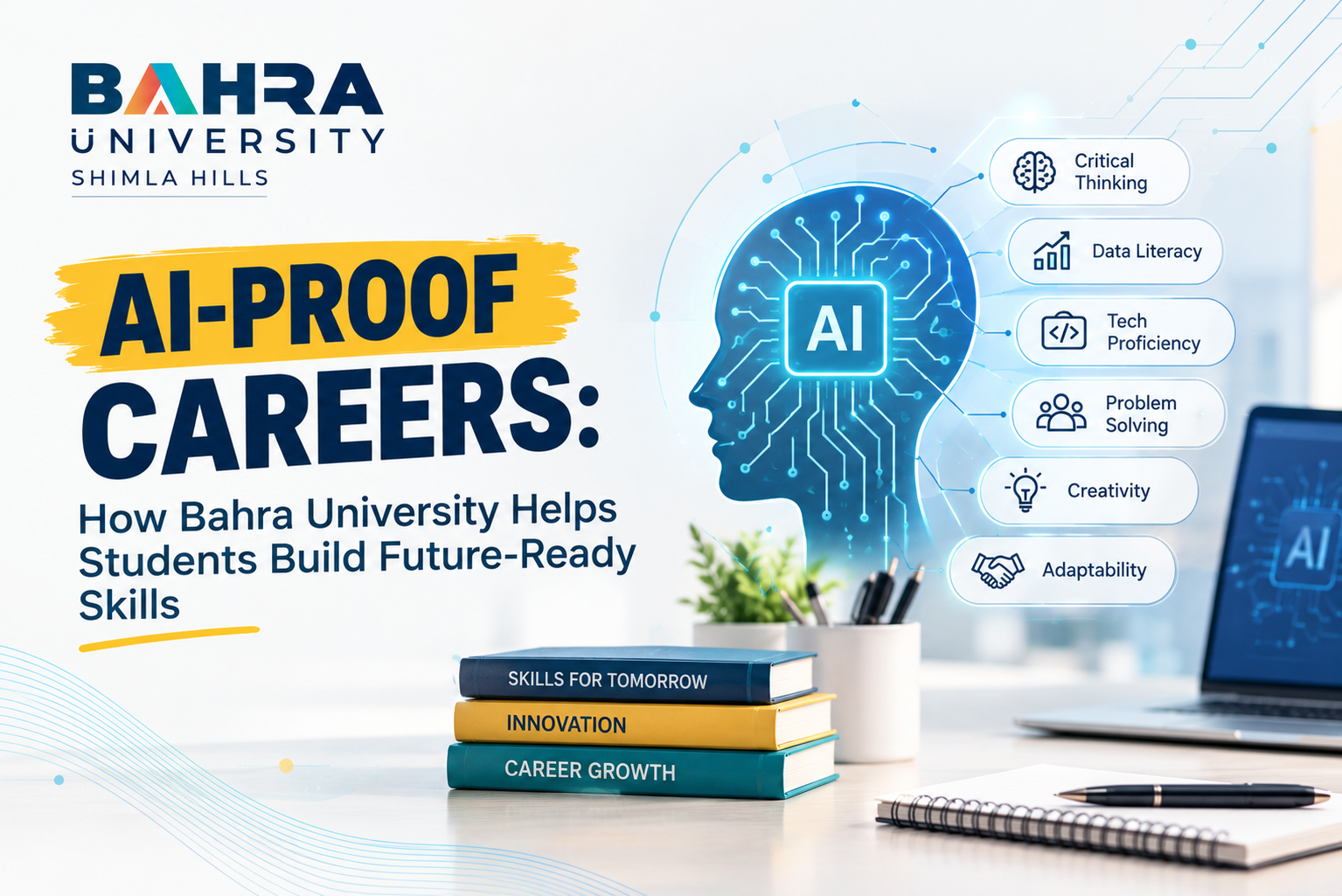
Careers that depend on human judgement, relationship management, creativity, ethical reasoning, and complex decision-making are generally more resistant to automation. Critical thinking, adaptability, communication, leadership, emotional intelligence, and problem-solving are repeatedly identified as core future-ready skills.
At the same time, AI literacy is becoming a baseline expectation. Students need to understand how AI systems work, where they fail, how to use them responsibly, and how to apply them within their chosen field whether that field is engineering, business, law, healthcare, hospitality, or media.
Bahra University’s Future-Ready Approach
Bahra University, located at Waknaghat in Solan, Himachal Pradesh, offers a multidisciplinary academic environment spanning engineering, management, law, pharmacy, computer applications, hospitality, sciences, and other professional disciplines. Its stated approach combines academic learning with internships, industry projects, workshops, research, innovation, and skill development.
What makes this relevant in the AI era is the university’s effort to connect classroom concepts with workplace application. Rather than treating technology as a separate subject, Bahra embeds emerging technologies, practical projects, and employability training across its academic ecosystem.
Industry-Linked AI and Technology Programmes
Bahra University has built specialised pathways in areas where AI is already transforming work: artificial intelligence, machine learning, data science, cybersecurity, cloud computing, and business analytics. Its Alpha School offers industry-oriented specialisations in AI/ML, Data Science, Business Analytics, Cybersecurity, and Cloud Computing.
The university’s B.Tech CSE in AI with Microsoft is one example of this industry-integrated model. The programme covers machine learning, deep learning, data science architecture, cloud computing, Azure DevOps, generative AI, cloud security, and AI projects, with exposure to Microsoft resources and industry practices.
Other technology-focused options include B.Tech and BCA pathways in AI, data science, cybersecurity, cloud, and related fields. These programmes are designed to give students both foundational computing knowledge and applied skills in automation, neural networks, data visualisation, Python, and machine learning.
Learning by Doing, Not Only by Theory
AI-ready graduates need portfolios, not just marksheets. Bahra University emphasises hands-on learning through live projects, internships, hackathons, industrial visits, laboratory training, guest lectures, and professional certifications.
This matters because employers increasingly want evidence that a student can apply knowledge. A student who has built a data dashboard, tested an AI model, participated in a hackathon, or completed an internship can demonstrate initiative and problem-solving far more convincingly than one who has only studied theory.
The university’s School of CSE highlights real-world projects, internships, global certifications, and an industry-aligned curriculum across AI, data science, cybersecurity, cloud computing, and full-stack development.
Certifications That Signal Readiness
Certifications do not replace a degree, but they can help students demonstrate current, job-relevant skills. Bahra University offers value-added certification and skill modules aligned with technology vendors, including Microsoft, IBM, and AWS-related learning pathways.
Students are also being trained through the Microsoft Azure AI Fundamentals (AI-900) certification programme, which focuses on AI and cloud-computing fundamentals. For a student entering an AI-influenced job market, such credentials can strengthen a résumé especially when paired with projects that show practical application.
Human Skills Remain the Differentiator
Technical ability alone will not make a career durable. As AI takes over repetitive and rules-based tasks, employers are placing greater value on communication, teamwork, leadership, ethical judgement, resilience, and the ability to work with people from different backgrounds.
Bahra University addresses this through its Placement Cell and Centre for Career Success, Employability and Skill Development Training Cell. These bodies provide workshops, seminars, personality development programmes, mock interviews, group discussions, career counselling, and industry interactions.
The university’s 24-day Placement Readiness Boot Camp, for example, trains final-year students in aptitude, technical competency, communication, personality development, leadership, professional etiquette, problem-solving, résumé writing, group discussions, and interview preparation.
Industry Partnerships and Placement Support
Bahra University has signed MoUs with organisations including IBM, HCLTech, L&T, and upGrad to support internships, skill development, joint research opportunities, and hands-on training. These partnerships help students encounter real industry expectations before graduation.
The university’s placement ecosystem includes career counselling, internship assistance, campus recruitment drives, mock interviews, résumé building, and industry-oriented workshops. Bahra reports a recruiter network of more than 1,175 organisations and over 8,100 job offers for students, although individual outcomes naturally vary by programme, student effort, and market conditions.
Skills Students Should Build Deliberately
A future-ready student should treat university as a training ground for both human and technological strengths. The most useful combination is not “AI versus soft skills,” but AI fluency plus human depth.
| Skill area | Why it matters | How students can build it |
| AI and data literacy | AI tools are entering nearly every profession | Learn Python, data analysis, prompt use, and responsible AI practices |
| Critical thinking | AI outputs need verification and context | Question assumptions, compare sources, and defend decisions |
| Communication | Ideas create impact only when understood | Practise presentations, writing, interviews, and storytelling |
| Collaboration | Most real work is team-based | Join clubs, hackathons, group projects, and community initiatives |
| Ethical judgement | AI raises questions of privacy, bias, and accountability | Study AI ethics and apply them in projects |
| Adaptability | Tools and job roles will keep changing | Learn one new tool or skill every semester |
Research on future-ready careers consistently highlights critical thinking, emotional intelligence, complex problem-solving, persuasive communication, and adaptability as among the most AI-resistant capabilities.
A Practical Roadmap for Students
Students at Bahra University can make their education more AI-proof by following a simple, consistent plan:
- Master the fundamentals of your field. AI can assist an engineer, lawyer, manager, or pharmacist, but it cannot replace domain understanding.
- Learn one AI tool deeply. Move beyond basic usage; understand its limitations, data needs, and ethical risks.
- Build a public portfolio. Document projects, internships, hackathons, certifications, and measurable outcomes.
- Practise human skills intentionally. Volunteer to present, lead a team, mentor juniors, or organise an event.
- Use placement resources early. Attend mock interviews, workshops, and career counselling from the first or second year, not only in the final year.
- Stay curious. Follow developments in your industry and update your skills every six to twelve months.
Bahra University’s Curriculum and Industry Tie-Ins
Bahra University’s approach to career preparation combines degree-level foundations with specialised learning, practical work, and employer-facing preparation. The university’s B.Tech CSE–AI with Microsoft programme offers a clear example: it pairs core AI and machine-learning study with topics such as deep learning, data-science architecture, generative AI, cloud computing, Azure DevOps, cloud security, and AI projects.
From computing foundations to applied AI
The Microsoft-linked programme is described as a four-year degree designed to build both theoretical knowledge and hands-on experience. Its published curriculum moves from foundational AI and machine learning towards more advanced applications, including generative AI and cloud-based development. That breadth matters: graduates need not only to understand models, but also to work with data, deploy applications, and consider security.
Bahra also lists related study options in areas such as AI, AI/ML, and BCA in Artificial Intelligence. The exact course options and requirements can change, so applicants should check the current programme and syllabus details for their intended intake.
What the industry partnerships add
Bahra University announced four MoUs with upGrad, IBM, HCLTech, and Larsen & Toubro (L&T). The university says the partnerships are intended to support internships, joint research, skill-development programmes, workshops, certifications, and knowledge-sharing.
The announced IBM collaboration specifically mentions global certification programmes and digital badges, as well as internships, guest lectures, and industry projects. These activities can give students opportunities to practise professional skills and build evidence of their work beyond classroom assessments. The announcement describes the intended opportunities; it does not specify that every student will receive each one, or list the exact courses and placements attached to every partner.
Connecting learning to recruitment
The Placement Cell supports the transition from study to work through career counselling, workshops, seminars, personality-development programmes, mock interviews, group discussions, industry visits, guest lectures, and campus recruitment drives. These activities address both technical employability and the communication and interview skills needed to present that expertise to employers.
Together, the curriculum and industry connections can create a useful learning cycle: students build a foundation in their discipline, apply it in projects or internships, and then practise communicating their skills to employers. A student studying AI, for example, could connect machine-learning coursework with a portfolio project, seek an internship or industry project, and use placement workshops to explain the project clearly in an interview.
Final Thoughts
There may be no permanent “AI-proof” job title, but there are AI-proof professionals: people who can learn continuously, use technology responsibly, communicate clearly, and bring human judgement to complex problems. Bahra University’s mix of AI-focused programmes, industry partnerships, practical projects, certifications, and placement preparation reflects this understanding.
For students, the message is clear: do not prepare merely for today’s job description. Prepare to work alongside intelligent systems, lead people, solve unfamiliar problems, and keep evolving. That is what will make a career genuinely future-ready.
