How Internships Bridge Classroom Theory and Career Readiness at Bahra University
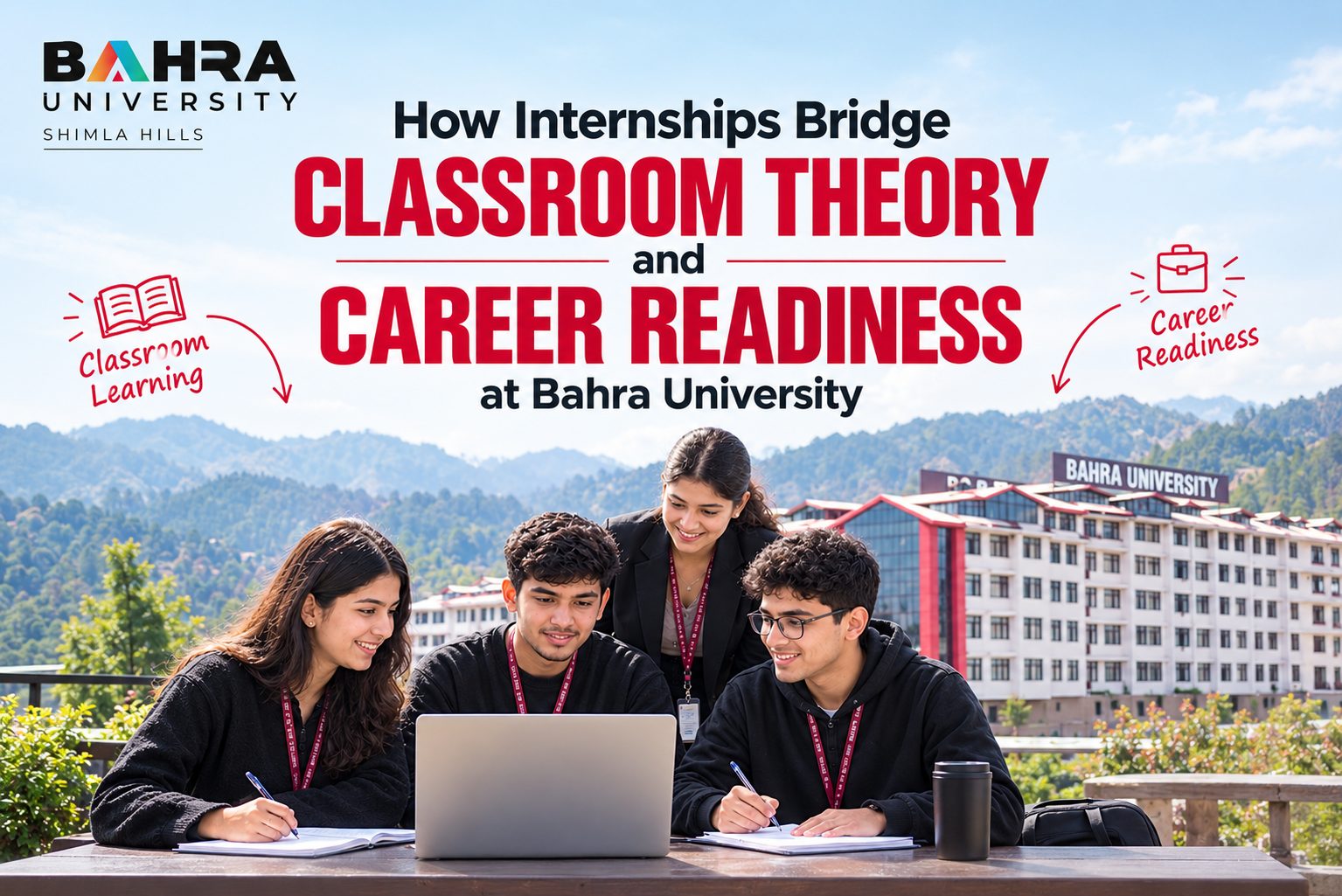
For students, the journey from a classroom to a professional workplace is not always straightforward. A lecture can explain a concept, a textbook can introduce an industry, and an examination can test understanding, but a real workplace teaches students how to use that knowledge when deadlines, people, clients, systems, and unexpected problems come into the picture.
At Bahra University, internships, Industrial Practice, industrial visits, field exposure, and placement-oriented training help make this transition smoother. These experiences are important because they do not treat education and employment as two separate stages. Instead, they connect them. Students begin building professional confidence while they are still learning, supported by faculty guidance and structured opportunities to engage with industry.
Learning Beyond the Classroom
Classroom learning gives students the language of a discipline. Engineering students learn design principles, programming, mathematics, and systems. Management students study finance, marketing, operations, and organisational behaviour. Hospitality students explore service standards, travel operations, and customer experience. Physiotherapy students learn anatomy, rehabilitation methods, and patient-care concepts.
However, professional work demands more than subject knowledge. It requires students to understand how people work together, how decisions are made, how standards are maintained, and how a theoretical solution is adjusted to suit a real situation.
That is why experiential learning matters. A student can study customer service in a classroom, for example, but a hotel visit reveals how front-office teams handle guest expectations, coordinate departments, manage complaints, and maintain service quality during busy hours. Similarly, a student who learns data analysis in an academic setting gains a different level of understanding when asked to organise information, identify a pattern, and communicate findings to a supervisor.
Bahra University’s Industrial Practice programme has been created to support this movement from theory to application. The university describes Industrial Practice as a course that enables students to experience an industry setting while remaining students. More importantly, it expects them to identify and solve real-time organisational problems within their allotted industry environments, known as Industry Practice Centres.
This is a meaningful distinction. An internship should not be only about observing professionals at work. Its greatest value comes when students are encouraged to contribute, ask questions, learn from feedback, and understand how their academic knowledge can create practical value.
Industrial Practice as Career Training
The Industrial Practice model at Bahra University gives students a structured way to engage with the professional world. Student allotment to Industry Practice Centres takes into account factors such as academic performance, industry requirements, student preferences, and other parameters considered relevant by the university.
This approach recognises that students have different strengths, interests, and career goals. A student who is interested in entrepreneurship may benefit from a setting where innovation and business development are visible. Another student may want exposure to corporate processes, technical work, healthcare practice, research, hospitality operations, or public-facing roles.
The programme also carries responsibility. Students participating in Industrial Practice are expected to treat it seriously as part of their academic journey. The university notes that students enrolled in Industrial Practice, thesis, or entrepreneurial courses cannot simultaneously register for another on-campus course. It may also withdraw a student if performance is unsatisfactory or if there are disciplinary concerns.
This structure mirrors the professional world. In an organisation, commitment, discipline, reliability, and ethical conduct matter as much as knowledge. By learning these expectations before graduation, students become better prepared for their first job.
Turning Concepts into Skills
One of the biggest advantages of internships is the development of skills that are difficult to gain through lectures alone. These include communication, teamwork, adaptability, time management, problem-solving, and professional behaviour.
Consider a management student who has studied marketing theory. During an internship, that student may be asked to assist with social-media content, observe customer responses, organise data, support an event, or prepare a short report. At first, the task may appear simple. But it requires the student to apply many skills together: understand the brief, meet the deadline, communicate with colleagues, make choices based on available information, and revise work after receiving feedback.
This is where real learning happens. Students begin to see that professional success is rarely based on one skill alone. It is based on the ability to combine knowledge, initiative, communication, and responsibility.
The same applies across disciplines:
- An engineering student learns how technical work is documented, reviewed, tested, and communicated within a team.
- A hospitality student observes how guest service, operations, safety, and coordination affect an organisation’s reputation.
- A healthcare student learns that technical knowledge must be combined with empathy, ethical care, patient communication, and teamwork.
- A law student learns how research, documentation, interpretation, and professional presentation influence legal work.
- A business student understands that decisions involve people, budgets, risk, and changing market realities, not only theoretical models.
By experiencing these realities early, students become more confident and practical in their approach to work.
What Industrial Visits Add
Industrial visits are another important bridge between academic learning and career awareness. They introduce students to work environments before they begin a longer internship or enter a full-time role. Instead of only discussing an industry in class, students can see how it operates.
Bahra University’s Placement Cell coordinates industry visits and guest lectures to help students understand industry trends, corporate culture, and the skills required for specific roles. These activities allow students to hear directly from professionals and see how workplace expectations differ from assumptions students may form through textbooks or social media.
The university’s published newsletter offers a useful example from the School of Hospitality and Tourism. Students visited The Zion Hotel in Shimla as part of an industrial tour and gained practical experience. The newsletter explains that such industrial tours are intended to take learning beyond the classroom and contribute to the holistic development of students.
For hospitality and tourism students, a hotel visit can turn classroom topics into visible systems. They can observe reception procedures, food and beverage operations, housekeeping standards, guest interaction, event arrangements, and service coordination. The experience helps students understand that hospitality is not simply about welcoming guests; it is a carefully managed operation where timing, teamwork, professionalism, and attention to detail matter every day.
The same newsletter also highlights an educational field trip by the tourism department to Uttarakhand, covering places including Haridwar, Jim Corbett National Park, Nainital, Dehradun, Mussoorie, and Rishikesh. Students were exposed to cultural practices and tourism activities such as jungle safaris, hiking, river rafting, horse riding, and visits to nature sites and a butterfly museum.
Such visits are valuable because tourism cannot be understood only as a chapter in a book. Students need to observe destinations, visitor behaviour, facilities, local culture, sustainability concerns, and the experience economy firsthand. They begin to connect academic ideas with the practical realities of planning and managing travel experiences.
Placement Support and Professional Confidence
Internships and industrial visits prepare students for work, but they are most effective when combined with career guidance. Bahra University’s Placement Cell supports students in securing internships, jobs, and career-development opportunities. It serves as a platform through which students can connect with employers and industry leaders.
The Placement Cell organises workshops, seminars, personality-development programmes, mock interviews, and group discussions. These activities focus on soft skills, interview techniques, and professional conduct areas that often influence whether a capable student can communicate their potential effectively in a hiring process.
Mock interviews are especially useful. A student may know the answer to a technical question but still struggle with nervousness, unclear communication, or an inability to explain their own project work. Practising in a structured setting helps students identify these gaps early. Group discussions, meanwhile, teach students how to express an opinion, listen respectfully, build on another person’s idea, and remain composed under pressure.
The Placement Cell also invites companies and organisations to campus for recruitment drives, giving students opportunities to interact directly with potential employers and apply for positions. Career counselling is another important part of this support, helping students identify their strengths, explore career paths, and make informed professional decisions.
From Experience to Employability
The true outcome of an internship is not merely a certificate. It is a student’s ability to say: “I have applied what I learned. I understand how work happens. I can communicate, collaborate, solve problems, and improve through feedback.”
When students complete an internship thoughtfully, they return to the classroom with better questions. They understand why a particular theory matters, why accuracy is important, why deadlines cannot be ignored, and why professional relationships shape outcomes. They also gain material for resumes and interviews. Instead of making general claims about their skills, they can describe a real project, a challenge they handled, a tool they used, or an improvement they suggested.
At Bahra University, the combination of Industrial Practice, industrial visits, professional training, and placement support gives students multiple opportunities to develop this readiness. The objective is not just to help students obtain a job after graduation. It is to help them enter the professional world with awareness, confidence, adaptability, and a strong sense of responsibility.
Conclusion
Career readiness does not begin on the day a student attends their first job interview. It develops gradually through exposure, practice, reflection, and feedback. Internships and industrial visits give Bahra University students a chance to learn from real workplaces while still benefiting from academic support.
By connecting classroom theory with real organisational challenges, Industrial Practice helps students understand the purpose behind their education. Industrial visits make industries visible and relatable. Placement training strengthens confidence and employability. Together, these experiences help students move from being learners of a subject to becoming professionals who are ready to contribute meaningfully from day one.
