Microbiology as a Career: What Do You Study and Where Can It Take You?
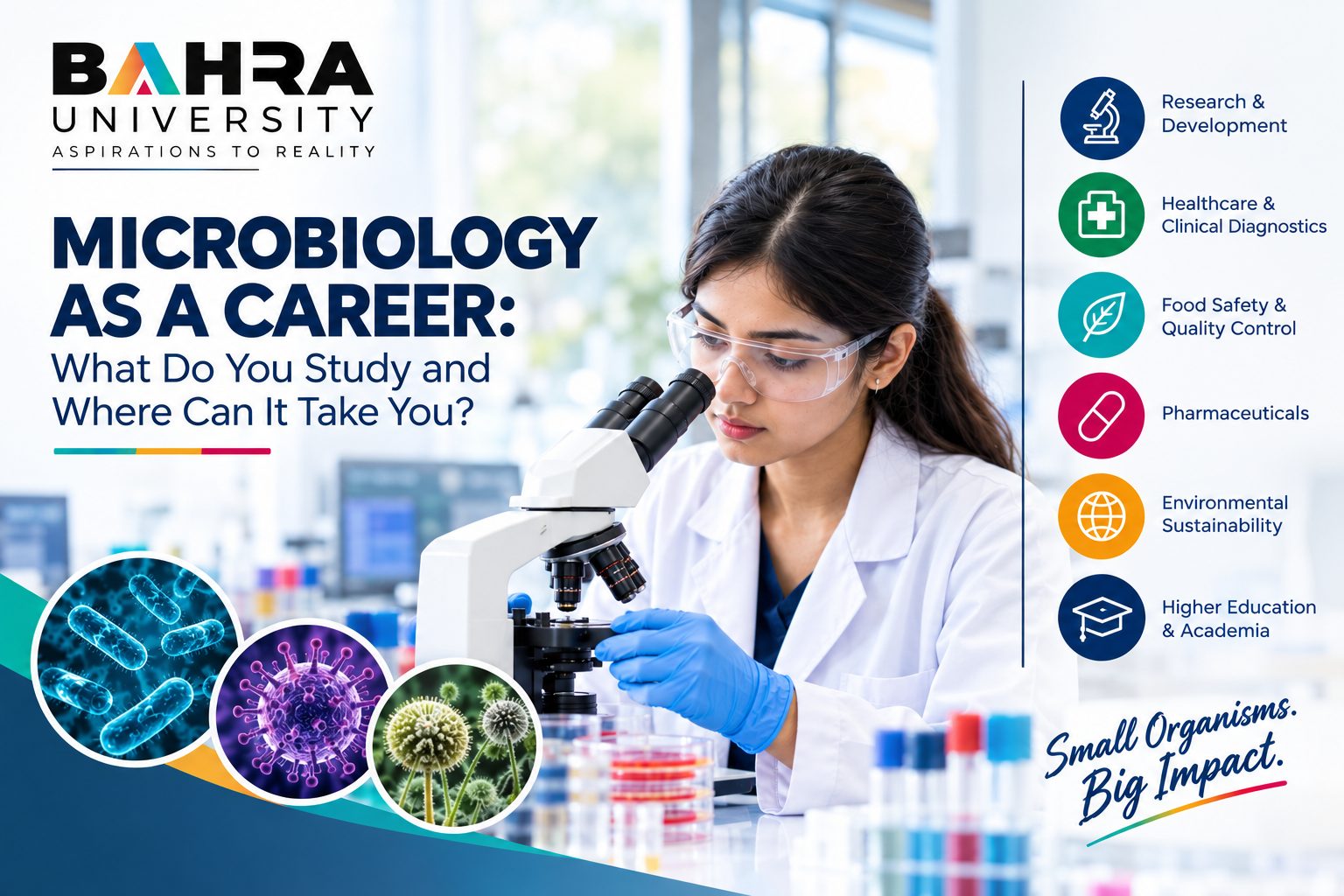
Microbiology is the study of microorganisms tiny living organisms such as bacteria, viruses, fungi, algae, and parasites that cannot usually be seen with the naked eye. Although these organisms are small, their impact is enormous. They influence human health, food safety, medicines, agriculture, the environment, industrial production, and even climate-related processes.
If you have ever wondered how infections spread, how antibiotics work, why food spoils, how vaccines are tested, or how microbes can help clean polluted water, microbiology may be the right career path for you.
At Bahra University, students can pursue B.Sc. Microbiology and M.Sc. Microbiology through the School of Basic Sciences. The B.Sc. programme is open to students who have completed Class 12 with Physics, Chemistry, and Biology and meet the university’s prescribed eligibility criteria. The university also lists Microbiology as a postgraduate specialisation for science graduates.
What is microbiology?
Microbiology is a branch of life science that examines microorganisms and their interaction with humans, animals, plants, food, medicines, and the environment.
Some microorganisms cause diseases, while others are essential for life and industry. For example, bacteria are used to make curd and other fermented foods, yeast is used in baking, microbes help produce certain medicines, and beneficial microorganisms are used in agriculture and wastewater treatment.
Modern microbiology goes far beyond studying microbes under a microscope. It includes disease diagnosis, microbial genetics, industrial fermentation, food testing, environmental monitoring, pharmaceutical quality control, infection prevention, biotechnology, molecular biology, and clinical research.
A microbiologist may test a food sample for contamination, identify disease-causing organisms in a laboratory, study antibiotic resistance, support medicine-quality testing, investigate water quality, or work on a research project involving microbial genetics.
What do you study in microbiology?
Microbiology is a practical and laboratory-oriented subject. It combines biology and chemistry with scientific methods, laboratory skills, research documentation, and data analysis.
During a microbiology programme, students may study subjects such as:
- General microbiology
- Bacteriology
- Virology
- Mycology
- Parasitology
- Immunology
- Microbial genetics
- Molecular biology
- Biochemistry
- Medical microbiology
- Food and dairy microbiology
- Industrial microbiology
- Environmental microbiology
- Microbial biotechnology
- Cell biology
- Bioinformatics
- Research methodology and scientific writing
Students also learn practical skills such as preparing culture media, maintaining microbial cultures, staining and microscopy, sterilisation techniques, microbial identification, aseptic handling, laboratory safety, sample testing, record keeping, and interpretation of results.
These skills are important because a successful microbiology career needs more than theoretical knowledge. Students must be careful, methodical, patient, ethical, and confident in laboratory procedures.
Study Microbiology at Bahra University
Microbiology at Bahra University: Courses and Eligibility
If biology, chemistry, and lab-based science genuinely interest you, Microbiology is worth a look. Bahra University’s School of Basic Sciences offers it across three levels, B.Sc., M.Sc., and PhD, so students can stay on this track right from undergraduate study through to doctoral research.
Here’s what you’ll need at each stage, based on the university’s current admission criteria:
- B.Sc. Microbiology
This is the right starting point if you’ve studied Physics, Chemistry, and Biology (PCB) in Class 12. You’ll need at least 50% marks in your 10+2 with these three subjects to be eligible.
- M.Sc. Microbiology
To apply here, you should already hold a bachelor’s degree in science, or an equivalent qualification, from a recognised institute, with a minimum aggregate of 50%.
- PhD in Microbiology
For doctoral study, you’ll need a master’s degree with at least 55% marks or an equivalent CGPA.
Each stage builds on the one before it, so whether you’re just finishing school with a science background or already holding a master’s and looking to move into research, there’s a clear path forward within the same department.
Learning beyond the classroom
Microbiology becomes meaningful when students can connect scientific principles with practical work. At Bahra University, students can benefit from the wider research and innovation ecosystem, including the Central Instrumental Facility, which is intended to provide shared access to advanced scientific instruments for interdisciplinary research.
The university also identifies Biotechnology and Healthcare as one of its key research domains and lists an Advanced Biotech Research Center focused on biomedical innovation and genetic engineering. These areas are closely relevant to students who want to explore molecular microbiology, diagnostics, microbial genetics, infectious-disease research, biotechnology, and healthcare research.
Across its research ecosystem, Bahra University reports more than 500 research papers, over 120 patents, and more than 50 industry-sponsored projects, along with collaborations involving organisations such as IITs, AIIMS, DRDO, and ISRO. These figures reflect the university’s wider research environment and are not specific to the Microbiology programme.
Why microbiology matters today
Microbiology is highly relevant to many of today’s biggest challenges. The field plays a role in infection control, food safety, public health, medicine manufacturing, antibiotic resistance, environmental protection, sustainable agriculture, and disease monitoring.
During a disease outbreak, microbiologists may support the testing and identification of pathogens. In a food company, they may check whether a product is safe for consumption. In a pharmaceutical company, they may help ensure that products meet strict quality and sterility standards. In environmental laboratories, they may analyse water and soil samples for microbial contamination.
Microbiology is also closely connected to biotechnology and data-driven science. As genetic testing, molecular diagnostics, genome sequencing, and bioinformatics become more common, students who combine microbiology knowledge with digital and analytical skills can create stronger career opportunities.
Career options after microbiology
A degree in microbiology can open doors to work in healthcare, laboratories, food production, pharmaceuticals, research, environment-focused organisations, and academic institutions. Your career path will depend on your qualification, laboratory skills, internship experience, specialisation, and willingness to pursue higher education where required.
Healthcare and diagnostic laboratories
Microbiology graduates may work in diagnostic laboratories, hospitals, pathology labs, blood banks, public-health laboratories, and clinical-testing facilities.
Possible roles include:
- Microbiology laboratory technician
- Diagnostic laboratory associate
- Sample-processing technician
- Clinical laboratory assistant
- Infection-control associate
- Research assistant
- Laboratory quality professional
Students who wish to work in specialised clinical or diagnostic settings can strengthen their profile through internships, certified training, practical laboratory exposure, and postgraduate studies.
Pharmaceutical and healthcare industry
Pharmaceutical and healthcare companies require professionals who understand microbes, contamination control, quality standards, laboratory processes, sterilisation, and safe manufacturing practices.
Possible career roles include:
- Quality-control analyst
- Quality-assurance executive
- Microbiology analyst
- Sterility-testing associate
- Production associate
- Validation associate
- Regulatory-affairs associate
- Clinical-research coordinator
- Pharmacovigilance associate
A microbiology background can be particularly useful in pharmaceutical manufacturing, where microbial contamination control and quality testing are essential.
Food and dairy industry
Microorganisms play an important role in both food production and food safety. Some microbes are used in fermentation, while others can spoil food or make it unsafe.
Microbiology graduates can work in food-processing companies, dairy plants, food-testing laboratories, beverage companies, packaged-food businesses, and quality-control units.
Potential work may include testing food and water samples, checking hygiene standards, monitoring fermentation processes, detecting contamination, and supporting quality systems.
Environmental science and sustainability
Microbes can be used to treat wastewater, break down pollutants, improve soil health, and support sustainable environmental practices. Environmental microbiology is a valuable area for students interested in conservation, water quality, waste management, pollution control, and sustainability.
Career opportunities may be available in water-testing laboratories, environmental consultancies, waste-treatment facilities, agricultural organisations, soil-testing labs, and sustainability projects.
For example, a microbiology professional may test drinking-water samples for contamination or study how helpful microorganisms can improve soil quality and crop productivity.
Research and higher education
Students who enjoy experiments, scientific discovery, reading research papers, and solving complex questions can build a career in research.
A common academic route is:
- Complete B.Sc. Microbiology.
- Pursue M.Sc. Microbiology or a related discipline such as biotechnology, molecular biology, genetics, biochemistry, clinical research, or bioinformatics.
- Build practical experience through laboratory projects, internships, conferences, and research training.
- Consider a PhD for advanced research, academic careers, independent scientific roles, and specialised research positions.
Research careers can lead to opportunities in universities, research institutes, hospitals, government laboratories, pharmaceutical organisations, agricultural research centres, and biotechnology companies.
Emerging areas in microbiology
Microbiology is changing quickly, and students can explore new and specialised areas as they progress in their education.
- Medical microbiology: Studying pathogens, infections, diagnostics, antimicrobial resistance, and public health
- Industrial microbiology: Using microbes in the production of enzymes, antibiotics, vaccines, fermented products, and other industrial materials
- Food microbiology: Ensuring food safety, preventing spoilage, and supporting fermentation processes
- Environmental microbiology: Applying microbial science to wastewater treatment, pollution control, waste management, and ecosystem health
- Molecular microbiology: Studying microbial DNA, genes, proteins, and cell processes
- Microbial biotechnology: Using microorganisms and biological processes to develop useful products and technologies
- Bioinformatics: Combining microbiology with computational tools to analyse biological and genetic data
- Clinical research: Supporting research studies, documentation, data management, and quality procedures in healthcare and pharmaceutical settings
Students who add skills in statistics, scientific writing, data analysis, basic programming, bioinformatics, and laboratory quality standards can become more competitive for advanced opportunities.
Is microbiology the right course for you?
Microbiology may be a good career choice if you:
- Enjoy Biology and Chemistry
- Are curious about diseases, microbes, medicines, food safety, or the environment
- Like laboratory experiments and scientific observation
- Can follow safety procedures and work carefully with samples
- Are patient, detail-oriented, and comfortable with documentation
- Want to build a career in healthcare, pharmaceuticals, research, food science, or environmental science
- Are willing to pursue internships, projects, and possibly higher education
It may be less suitable if you strongly dislike laboratory work, practical experiments, detailed record keeping, or continuous learning. Microbiology is an evolving scientific field, so staying updated with techniques, regulations, research developments, and technology is important.
How to build a strong microbiology career
A degree gives you the foundation, but your practical skills and learning attitude will shape your career.
Take laboratory practicals seriously from the beginning. Learn aseptic techniques, staining methods, culture handling, microscopy, sterilisation, sample processing, laboratory safety, quality documentation, and data interpretation. These are not just classroom activities, they are skills that employers and research supervisors value.
Try to participate in science seminars, workshops, research projects, poster presentations, student conferences, and laboratory training programmes. Such experiences help you understand current developments and give you confidence in professional settings.
Build digital skills as well. Knowledge of Microsoft Excel, scientific writing, presentation design, basic statistics, data visualisation, and bioinformatics can strengthen your profile. Students interested in genomics or molecular microbiology can gradually explore tools such as Python or R for scientific data analysis.
Internships are equally valuable. An internship in a diagnostic laboratory, food-testing facility, pharmaceutical company, hospital laboratory, water-testing lab, research institute, or biotechnology company can help students gain workplace exposure and identify the field they want to specialise in.
Conclusion
Microbiology offers a meaningful career path for students who want to understand the science behind health, disease, food, medicines, and the environment. It can lead to opportunities in diagnostic laboratories, pharmaceutical companies, food and dairy industries, research organisations, healthcare facilities, environmental testing, and higher education.
At Bahra University, students can study B.Sc. Microbiology, M.Sc. Microbiology, and PhD in Microbiology through the School of Basic Sciences. The programmes are designed to help students develop scientific knowledge, laboratory confidence, research awareness, and the practical skills needed for a future in life sciences.
If you are ready to turn your interest in biology into a professional career, explore Microbiology at Bahra University and take the next step towards opportunities in research, healthcare, industry, and scientific innovation.
