From Theory to Practice: Why Experiential Learning Matters in Higher Education
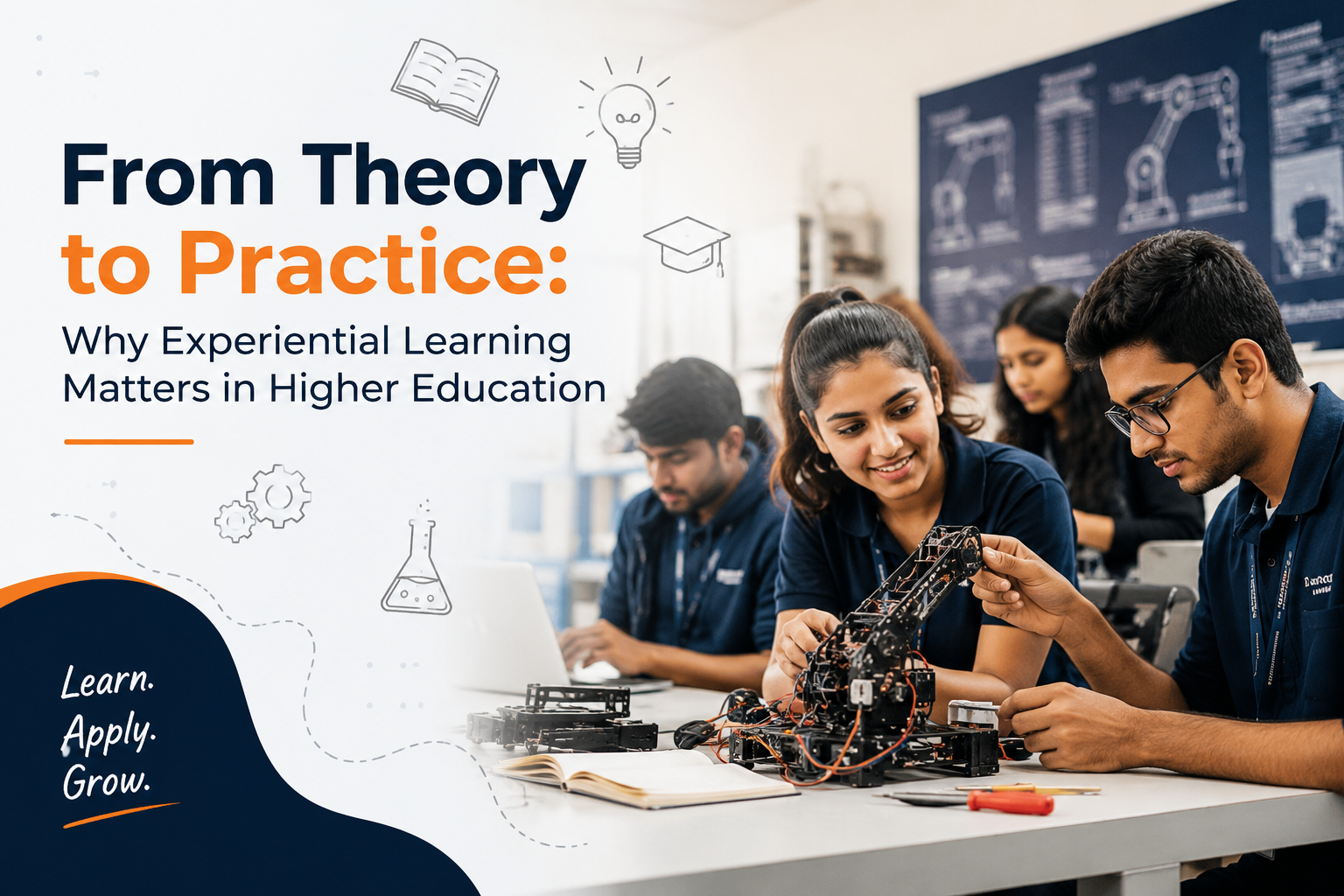
Picture two students finishing the same marketing course. One can recite the four Ps flawlessly on an exam. The other has actually launched a small campaign, watched it flop, tweaked it, and finally seen it work. Six months into their first job, guess which one adapts faster to a client who changes the brief on a Tuesday afternoon?
That gap between knowing and doing is exactly what experiential learning tries to close and it’s quickly becoming one of the most talked-about shifts in higher education today.
What Experiential Learning Actually Means
Experiential learning isn’t just a buzzword tacked onto a syllabus. At its core, it’s a simple idea: people learn best by doing, reflecting, and doing again. Instead of sitting through a lecture and memorizing a framework, students apply that framework to a real problem, a business case, a lab experiment, a community project, an internship and then reflect on what worked, what didn’t, and why.
This isn’t a new theory. Educational thinkers have championed “learning by doing” for over a century. What’s changed is how urgently universities need it. Employers today aren’t just hiring for what graduates know; they’re hiring for what graduates can do with what they know, collaborate under pressure, solve messy problems, communicate with real stakeholders, and learn quickly on the job.
Why Traditional Classroom Learning Alone Falls Short
There’s nothing wrong with lectures, textbooks, or theory; they build the foundation. The problem starts when theory is the only thing on offer. A student can ace every exam and still freeze the first time they’re handed an actual client, patient, or piece of broken code with no answer key attached.
Traditional models also tend to separate “learning” from “life,” treating the classroom as a rehearsal space that never quite becomes the real performance. Experiential learning collapses that separation. It puts students in situations with real stakes, even small ones, long before graduation day.
The Real Benefits of Learning by Doing
1. Deeper, Longer-Lasting Understanding
Concepts that are applied stick around far longer than concepts that are just memorized. When a student uses a statistical model to analyze real data instead of a textbook dataset, the learning becomes personal and personal knowledge is retained knowledge.
2. Stronger Problem-Solving and Critical Thinking
Real-world situations rarely come with tidy, single right answers. Experiential learning trains students to sit with ambiguity, test hypotheses, fail safely, and iterate skills no multiple-choice exam can teach.
3. Better Career Readiness
Internships, live projects, simulations, and industry collaborations give students something a transcript alone cannot: a portfolio of real experience they can talk about in interviews with confidence.
4. Emotional and Social Growth
Group projects, fieldwork, and community engagement build empathy, teamwork, and communication qualities that matter just as much as technical skill in most careers.
5. Higher Engagement and Motivation
Let’s be honest, students pay more attention when they can see the point of what they’re learning. Purpose is a powerful motivator, and experiential formats make that purpose visible almost immediately.
What Experiential Learning Looks Like in Practice
Universities are getting creative about how they bring theory into practice:
- Internships and apprenticeships that place students directly inside working organizations
- Live industry projects where companies bring real problems into the classroom
- Simulation labs for fields like healthcare, engineering, and aviation, where mistakes are safe but consequences feel real
- Community-based and service learning, connecting coursework to genuine social impact
- Case-study and project-based pedagogy, especially common in business and management programs
- Research assistantships, giving undergraduates a taste of real inquiry rather than just reading about it
An Institution Getting This Right: Bahra University
One place where this shift from theory to practice is visible rather than just promised is Bahra University in Himachal Pradesh, India. Rather than treating experiential learning as an add-on, Bahra University has built it into the fabric of how its programs are designed.
What stands out about Bahra University’s approach is its consistent emphasis on industry-integrated learning. Across its schools engineering, management, pharmacy, computer applications, and more the university leans heavily on internships, hands-on labs, live projects, and strong industry tie-ups that give students exposure to real workplace expectations long before they graduate. This isn’t learning happening in isolation from the professional world; it’s learning happening alongside it.
Bahra University also places noticeable weight on skill development and employability, pairing academic coursework with training that’s aligned to what employers are actually looking for. For students, that translates into a college experience that doesn’t just fill a transcript it builds a foundation of practical competence and confidence.
In a higher education landscape where many institutions still talk about “bridging the gap between academia and industry” without doing much to close it, Bahra University’s practice-oriented model is a genuinely encouraging example of what that bridge can look like when it’s actually built.
The Challenges Worth Acknowledging
None of this is to say experiential learning is easy to implement. It requires more faculty time, stronger industry partnerships, flexible curricula, and sometimes more resources than a traditional lecture-based model. Assessment gets trickier too grading a reflective project isn’t as straightforward as grading a multiple-choice test. But these are implementation challenges, not reasons to retreat from the approach. Institutions that invest in solving them are the ones producing graduates who hit the ground running.
Bringing It All Together
The shift from theory to practice isn’t about abandoning academic rigor, it’s about giving that rigor somewhere to go. Experiential learning asks students to do more than absorb information; it asks them to use it, question it, and grow through it. Institutions like Bahra University show that when universities commit seriously to hands-on, industry-connected education, students graduate not just with knowledge, but with the confidence and competence to apply it from day one.
As higher education continues to evolve, the institutions that thrive will be the ones that understand a simple truth: learning becomes real the moment it’s lived, not just studied.
